Posted by Scott Miller on 9th Feb 2026
How Homeschool Families Use Framed Historical Documents to Create Powerful Learning Environments
Walk into a thriving homeschool environment, and you'll often see something special on the walls: the Constitution, the Declaration of Independence, historical portraits, and American art. These aren't just decorations—they're essential teaching tools that create an immersive learning atmosphere where history isn't just studied, it's lived.
If you're homeschooling (or considering it), you know that your learning environment matters. Unlike traditional classrooms that reset every year with new students, your homeschool space evolves with your children over years. The displays you choose become part of your family's educational culture.
Why Homeschool Families Invest in Historical Document Displays
It's Not About Decoration—It's About Immersion
Traditional schools have libraries, computer labs, and dedicated history classrooms filled with resources. Homeschool families create their own rich environments at home. Framed historical documents transform dining rooms, studies, and learning spaces into places where American history is honored and accessible.
How to Use Framed Documents Across Grade Levels
Elementary (K-5): Building Foundations
The Preamble becomes routine:
- Start each day with recitation. Having the Constitution on the wall makes this natural.
Morning routine example:
- Stand together facing the Constitution
- Recite the Preamble in unison
- Discuss one new word each week
- By age 10, they've memorized it through repetition, not forced memorization
Visual learning activities:
- "I Spy History": "Find the word 'Congress' on the Constitution wall"
- Copywork practice: Elementary students copy sentences from the visible document
- "Document of the Week": Focus on different parts throughout the year
What kids learn:
- These documents are important (we display them prominently)
- American history is part of our daily life
- Foundational civic literacy through exposure
Middle School (6-8): Deep Dives and Analysis
Close reading stations:
Stand at the framed document and analyze specific sections:
- Article I, Section 8: What powers does Congress have?
- Amendment I: What freedoms are protected?
- Preamble: What are the six purposes of government?
Document comparison activities:
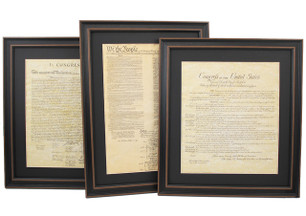
With Constitution, Declaration, and Bill of Rights all displayed:
- Compare language and writing styles
- Trace development of American ideals
- Analyze differences in purpose and audience
Constitution Day projects (September 17):
- Create presentations about specific amendments
- Debate historical constitutional questions
- Photograph themselves next to documents for project presentations
Middle school milestone:
By 8th grade, students can reference specific Articles and Amendments from memory because they've seen them hundreds of times.
High School (9-12): College-Prep Depth
AP Government at home:
Your framed Constitution becomes a constant reference tool:
- Quiz yourself: "Recite Article II from memory, then check the wall"
- Debate prep: Walk to the document during political discussions
- Essay writing: Reference specific clauses visible in your learning space
Civic engagement projects:
- Analyze current events through constitutional lens
- Write papers comparing founders' intent with modern interpretation
- Create video presentations with documents as backdrop
Senior year capstone:
Many homeschool families do a "Constitutional Defense" project where graduating seniors must defend the entire Constitution, Article by Article—using their wall display as reference.
Creating Your Homeschool History Wall
Option 1: The Founding Documents Core
Start with the essentials:
- Constitution
- Declaration of Independence
- Bill of Rights
Why this works:
Covers founding era comprehensively. Perfect for families doing chronological US history over multiple years.
Room for growth:
Add historical portraits, Revolutionary War art, or presidential displays as budget allows.
Option 2: The Timeline Approach
Build history chronologically on your walls:
- Wall 1: Revolutionary War era (Declaration, Revolutionary War art, founding portraits)
- Wall 2: Constitutional era (Constitution, Bill of Rights, Constitutional Convention scenes)
- Wall 3: Civil War era (Emancipation Proclamation, Gettysburg Address, Lincoln portraits)
- Wall 4: Modern America (later amendments, 20th century historical moments)
Why it's powerful:
As you teach chronologically through history, different walls become focus areas. You're literally walking through time.
Option 3: The Living Room Learning Gallery
Not everyone has a dedicated school room. Many homeschoolers use main living areas. This approach integrates learning into family life:
- Formal dining room wall: Founding documents create a dignified, educational atmosphere
- Home office: Historical art and portraits for older students studying independently
- Hallway gallery: Presidential portraits or historical timeline as you walk through the house
- Family room: Large-scale historical scenes as conversation starters
Why it works:
Education isn't confined to "school hours." These displays make learning part of family culture 24/7.
Subjects Enhanced by Historical Displays
Obviously: History & Government
- US History (K-12)
- Government/Civics (9-12)
- State History
- World History (for context)
Surprisingly Effective: Language Arts
Grammar studies:
Analyze 18th-century sentence structure in the Declaration
Vocabulary building:
Words like "posterity," "prudence," "despotism" come from daily exposure
Copywork:
Elementary students practice handwriting by copying from historical documents
Essay writing:
Analyze rhetorical devices: parallelism, repetition, appeals to emotion
Close reading skills:
Parse complex sentences, identify main ideas, understand historical context
Critical Thinking & Logic
Debate preparation:
Reference actual constitutional text during policy debates
Logical reasoning:
"What does this clause actually say vs. what do people think it says?"
Original sources:
Teach kids to go to primary sources, not summaries
Surprisingly: Math & Science
Timeline mathematics:
Calculate years between events, ages of founders, etc.
Statistics:
Amendment ratification rates, census data (mentioned in Constitution)
Scientific thinking:
Enlightenment influence on founders—teach 18th-century scientific revolution context
Practical Homeschool Tips
Where to Display in Different Home Setups
Dedicated school room:
Create an entire wall of founding documents and historical art—your own classroom atmosphere
Kitchen table schoolers:
Dining room wall visible from table becomes your "classroom board"
Living room learners:
Formal living room walls create scholarly environment
Bedroom learners:
Older students appreciate historical displays in their study spaces
Multiple learning zones:
Different documents in different rooms—Constitution in study, Declaration in living room, Bill of Rights in hallway
Installation Tips for Homeschool Families
Height considerations:
Hang at average adult eye level (60 inches center). Kids grow up and appreciate adult-height displays long-term.
Avoid:
- Direct sunlight (fades documents over time)
- Behind furniture that blocks view
- High-traffic play areas where younger kids might damage
Secure hanging:
Use heavy-duty hangers. With toddlers around, make sure everything is secure.
Curriculum Integration Ideas
Charlotte Mason Method
Historical documents perfectly align with Charlotte Mason's emphasis on:
- Living books and primary sources
- Beautiful, high-quality materials
- Nature and environment of learning
- Copywork from original sources
How to integrate:
Use documents for copywork, narration practice, and picture study of historical paintings.
Classical Conversations
Documents support all three stages:
Grammar Stage (K-4):
Memorization through daily exposure—Preamble, famous phrases
Logic Stage (5-8):
Analyzing structure, comparing documents, understanding argument flow
Rhetoric Stage (9-12):
Defending constitutional principles, crafting arguments, college-level analysis
Unit Studies
Build entire units around displayed documents:
Founding Fathers Unit:
- Display portraits of Washington, Franklin, Jefferson, Adams
- Study biographies while viewing their portraits daily
- Compare their contributions referenced in Constitution
Revolutionary War Unit:
- Display Declaration and Revolutionary War art
- Learn about events while surrounded by visual context
- Culminate with Constitution ratification study
Budget-Friendly Approaches for Growing Families
Start Small, Build Over Years
- Year 1: Constitution only (poster size for visibility)
- Year 2: Add Declaration of Independence
- Year 3: Add Bill of Rights
- Year 4: First historical portrait or art piece
- Year 5: Second art piece
By the time your oldest reaches high school, you have a comprehensive collection built gradually within budget.
Co-op Group Buys
Many homeschool co-ops organize group purchases:
- 5-10 families order together
- Sometimes get bulk pricing
- Share shipping costs
- Create matching "classroom" environments
Fundraising Ideas
Grandparent gifts:
"Instead of toys for Christmas, could you contribute to our homeschool history wall?"
Curriculum budget allocation:
Trade consumable workbooks for permanent displays:
- Skip one year of expensive history workbooks
- Invest in documents that serve for many years
Used curriculum budget:
Money saved buying used math/science books can fund permanent history displays
What Makes This Different from Public School
Permanence
Your displays stay up year after year. Students develop deep familiarity—not just semester-long exposure.
Family Culture
These aren't just learning tools; they become part of your family identity: "We're a family that honors history and founding principles."
Multi-Child Benefit
Older siblings teach younger ones using the same displays they learned from. Documents become family teaching tools spanning generations.
Flexibility
You control when and how to use them:
- Spontaneous teaching moments
- Planned lessons
- Background learning through daily exposure
- Formal presentations
Special Homeschool Moments
Constitution Day at Home (September 17)
Make it special with your displays as centerpiece:
- Morning: Constitutional breakfast—read Preamble together
- Midday: Each child presents on a different Article or Amendment (standing at the display)
- Afternoon: Constitution trivia game using the wall as reference
- Evening: Watch "Constitutional Convention" historical film
- Photos: Take annual Constitution Day photos in front of displays—create tradition
Graduation Ceremonies
Many homeschool families do home graduations. Historical document displays create:
- Dignified backdrop for photos
- Context for graduation speeches about civic responsibility
- Symbolic reminder of educational foundation
Photo opportunity: Senior stands between Constitution and Declaration—symbolic of educated citizenship
Visiting Grandparents/Friends
Your displays become conversation starters:
- Kids give "house museum tours"
- Explain what they've learned
- Share favorite historical facts
- Demonstrate knowledge naturally
Getting Started: Your Action Plan
This Month:
1. Measure your wall space
2. Decide: single document or foundational set?
3. Determine budget (remember: this is multi-year investment)
This Year:
1. Order and install your first piece(s)
2. Integrate into daily routine (morning recitation, etc.)
3. Plan 2-3 specific lessons using the displays
Long-Term:
1. Build collection gradually
2. Document learning moments with photos
3. Create traditions (Constitution Day, graduation photos, etc.)
4. Pass the tradition to your children when they homeschool their kids
Final Thoughts: More Than Homeschool Supplies
Framed historical documents aren't just educational materials. They're:
- Family heirlooms your children will remember from their education
- Visual representations of your educational values
- Teaching tools that work for 15+ years across multiple children
- Conversation starters that make history come alive
- Investments in civic literacy that compound over time
In the homeschool world, where you carefully curate every aspect of education, the environment you create matters. Historical documents displayed prominently send a daily message: *We value history. We honor founding principles. We're raising informed citizens.*
That message, repeated daily for 12+ years, creates lasting impact no workbook can match.
Ready to transform your homeschool environment?
Start with the foundational documents. Add historical portraits and art as you grow. Create an environment where American history isn't just studied during "history time"—it's part of the atmosphere where learning happens every day.
Your children deserve to learn surrounded by the documents and ideas that shaped America. Give them that advantage.
Quick Start Guide by Homeschool Type:
- Charlotte Mason families: Start with Constitution for copywork + 1 historical painting for picture study
- Classical Conversations: Full founding documents set for all three learning stages
- Unschoolers: Historical art and portraits that spark natural curiosity
- Traditional curriculum users: Documents that align with your history curriculum scope
- Unit study families: Build collection around units you teach
Recommended first purchase: Constitution + Declaration + Bill of Rights framed set